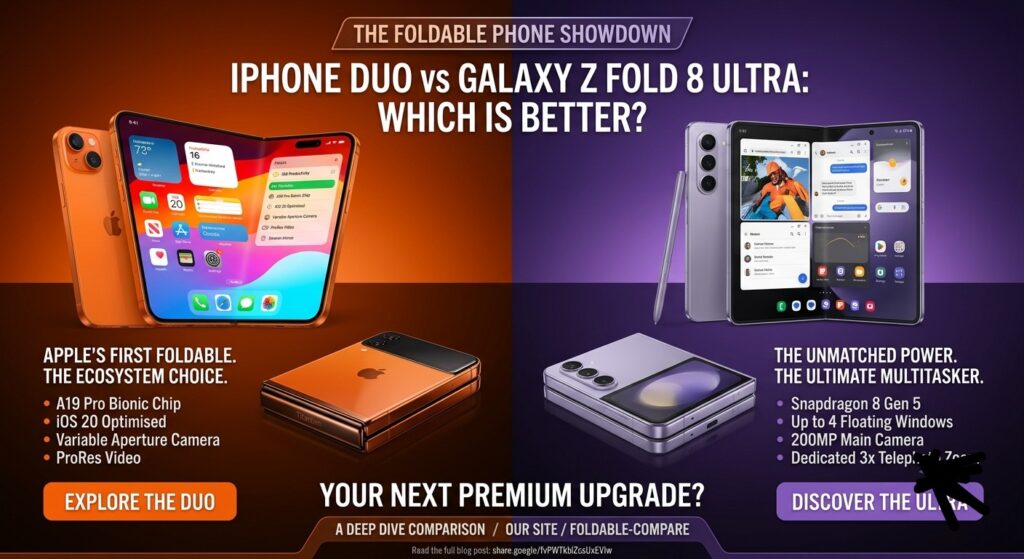

While both devices carry an ultra-premium price tag, Apple and Samsung have taken completely different philosophical approaches to their camera systems. Samsung priorithttpized raw hardware and zoom reach, whereas Apple focused on physical light control and professional video processing.
| Feature | Apple iPhone Duo | Samsung Galaxy Z Fold 8 Ultra.
Explore how these hardware specifications stack up:
Main Sensors and Versatility
Samsung’s massive 200MP main sensor is built to capture extreme detail and uses advanced pixel-binning to draw in light during nighttime photography.
Apple counters with a 48MP Fusion Main camera that boasts a variable aperture (f/1.48 to f/4.0). This gives the iPhone Duo a unique physical advantage: you can adjust the actual mechanics of the lens to capture natural bokeh (background blur) or keep wide landscapes in sharp focus, rather than relying solely on software to simulate the effect.
The Telephoto Divide
This is the most significant hardware gap between the two foldables. The Galaxy Z Fold 8 Ultra features a dedicated 10MP telephoto lens with 3x optical zoom, giving it vastly superior reach without degrading image quality.
To keep the Duo’s chassis as thin as possible, Apple entirely omitted a dedicated zoom lens. Instead, the iPhone relies on cropping into the high-resolution center of the main 48MP sensor to simulate a 2x zoom. If you frequently take photos of distant subjects or attend concerts, Samsung wins this category outright.
Video and Selfies
Video: Apple remains the go-to choice for creators. The iPhone Duo supports professional-grade ProRes, Dolby Vision HDR, and Spatial Video (designed for the Vision Pro headset) at up to 4K/120fps. While Samsung can record at a massive 8K/30fps resolution, Apple’s stabilization, dynamic range, and post-production toolkit are generally favored by videographers.
Selfies: The iPhone Duo takes the edge for everyday use. Its 12MP cover camera includes autofocus, making it sharper for selfies and quick FaceTime calls than Samsung’s 10MP fixed-focus setup. Both phones feature internal screen cameras that are best reserved for basic video conferencing.
Camera Capabilities
Foldables traditionally compromise on cameras to save space, but both “Ultra” and “Duo” monikers imply top-tier
photography.
Galaxy Z Fold 8 Ultra: Samsung borrowed the camera array directly from its Galaxy S-Ultra line. It features a stunning 200MP main sensor, a 50MP ultra-wide, and a dual-telephoto system (3x and 5x optical zoom). For zoom photography and high-res cropping, Samsung wins easily.
iPhone Duo: Apple keeps things streamlined with a custom 48MP main sensor, an upgraded 48MP ultra-wide, and a 5x tetraprism telephoto lens. Where the iPhone Duo truly shines is in its computational photography, unmatched video recording quality (ProRes 4K at 120fps), and seamless integration across the Apple ecosystem.
Battery Life and Charging
The Galaxy Z Fold 8 Ultra packs a massive 5,000 mAh dual-cell battery, supporting 65W fast charging that tops the device up in just under 45 minutes.
The iPhone Duo, bound by its incredibly thin chassis, houses a slightly smaller 4,600 mAh battery. However, Apple’s hardware-software synergy ensures all-day battery life, matching Samsung in real-world screen-on time. It supports 35W MagSafe charging and USB-C fast charging.
The Verdict: Which should you buy?
The choice between these two marvels comes down to what you value most in a smartphone.
Buy the Galaxy Z Fold 8 Ultra if: You are a power user who wants maximum productivity, extreme multitasking capabilities, stylus support (S-Pen), and an unmatched zoom camera system.
Buy the iPhone Duo if: You are already entrenched in the Apple ecosystem, prefer seamless and intuitive software over complex multitasking, and prioritize video recording quality and a nearly invisible hinge crease.