1. Navigation: Matrix Clean vs. Random Bounce Pattern
Standard robot vacuums rely on basic bump sensors or optical cameras. They move in a straight line until they strike an obstacle, then turn at a random angle. This creates a haphazard cleaning pattern that frequently leaves unvacuumed patches in the center of your rooms.
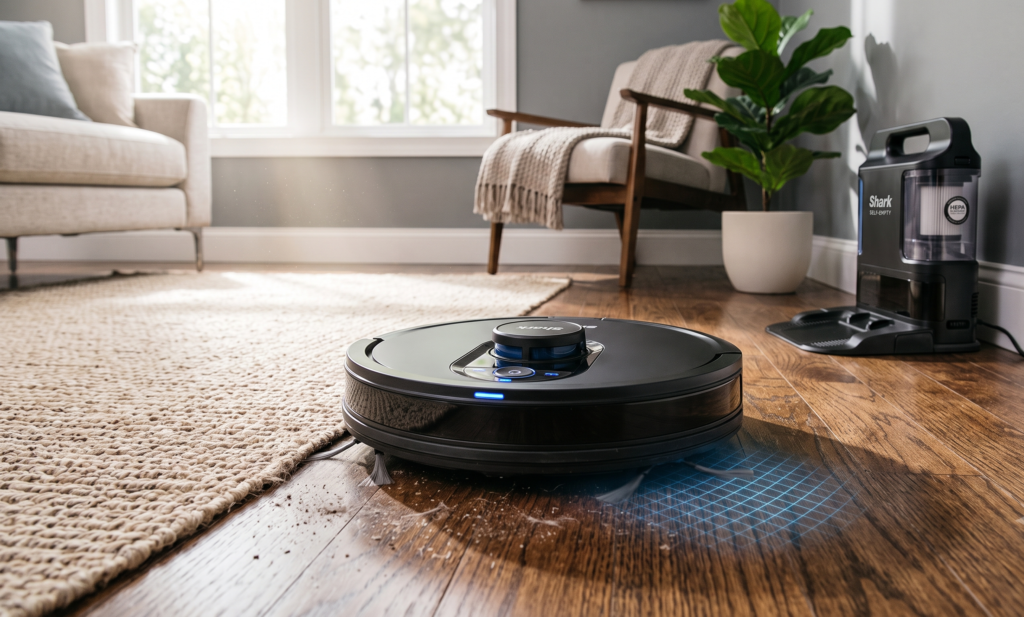
The Shark AV2501S is engineered with a raised 360-degree LiDAR (Light Detection and Ranging) laser system. It fires millions of invisible laser points to generate a precise floor plan of your entire home on its very first run. Combined with Shark’s proprietary Matrix Clean Navigation, the robot cleans using a tight, multi-directional grid pattern. It doesn’t just pass over an area once; it covers it side-to-side and back-and-forth, ensuring total floor coverage.
2. Base Maintenance: Bagless HEPA Base vs. Ongoing Bag Expenses
Most self-emptying robot vacuums use proprietary disposable paper bags inside their charging bases. While convenient, these bags act as a hidden recurring cost that can rack up an extra $40 to $70 per year.
The Shark AV2501S tackles this differently by featuring a completely bagless self-empty base. When the robot docks, it utilizes a powerful internal vacuum motor to forcefully pull debris out of the robot’s onboard bin and deposit it into a large, clear container located right on the dock. To empty it, you simply click a release button and dump the dust straight into your trash can. Best of all, the entire base is sealed with a True HEPA filtration system, trapping 99.97% of pet dander, micro-dust, and pollen down to 0.3 microns inside the base.
Shark AV2501S AI Ultra Robot Vacuum Review: Is This Bagless Self-Emptying Beast Worth It?
Disclaimer: This post contains affiliate links. If you make a purchase through these links, I may earn a small commission at no extra cost to you. As an Amazon Associate, I earn from qualifying purchases.
Keeping floors clean in a busy household—especially one filled with pets—can feel like a second full-time job. Traditional vacuums require your constant physical effort, while early-generation robot vacuums often got stuck under couches, missed entire sections of a room, or wrapped themselves in an ungodly amount of hair.
Enter the Shark AV2501S AI Ultra Robot Vacuum with Matrix Clean. Positioned as a direct competitor to high-end models from brands like iRobot Roomba, this vacuum promises true hands-free cleaning for up to 30 days without breaking the bank. But does it actually live up to the marketing hype?
In this deep-dive review and comparison guide, we’ll break down its real-world performance, unique engineering advantages, and see exactly how it stacks up against standard robot vacuums to help you decide if it’s the right choice for your home.
Quick Look: Shark AV2501S Technical Specifications
Before diving into the detailed comparison, let’s look under the hood at what the Shark AI Ultra brings to the table:
| Feature | Specification |
|---|---|
| Navigation System | 360° LiDAR Vision |
| Cleaning Mode | Matrix Clean Navigation (Grid Pattern) |
| Base Station Capacity | 30 Days (Bagless Dustbin) |
| Filtration | True HEPA Filtration (99.97% Efficiency) |
| Battery Life | Up to 120 Minutes (Recharge & Resume) |
| Smart Home Support | Wi-Fi, SharkClean App, Amazon Alexa, Google Assistant |
Comparison Guide: Shark AV2501S vs. Traditional Robot Vacuums
To truly understand the value of this model, it’s best to compare its structural design and functionality against what standard budget or mid-tier robot vacuums offer.
3. Brushroll Engineering: Self-Cleaning vs. Tangled Disasters
If you have pets or family members with long hair, you know the nightmare of taking a pair of scissors to a traditional vacuum brushroll to hack away tangled hair wraps. If left uncleaned, these tight tangles put immense strain on the vacuum’s motor, causing premature hardware failures.
Shark addresses this with an integrated self-cleaning brushroll. The roll uses a series of flexible rubber fins mixed with strategic bristles that actively separate hairs as they spin, preventing them from wrapping tightly around the axle. Instead, the hair is guided directly into the suction stream and pulled straight up into the dustbin.
Deep-Dive Performance Analysis
Hardwood and Tile Cleaning (Score: 9.8/10)
In independent testing, the Shark AV2501S proves to be an absolute powerhouse on hard floors, removing roughly 99.8% of surface debris. The dual spinning side brushes effectively sweep crumbs, dust bunnies, and kitty litter out of tight wall corners and direct them right into the main suction path.
Carpet Deep Cleaning (Score: 8.5/10)
On low-pile and high-pile carpets, the vacuum pulls up fine sand, dust, and heavy pet hair excellently due to its powerful suction airflow. However, if you have incredibly thick, plush carpeting, its lower-profile wheels can slow down slightly compared to its speed on hard surfaces. Its automatic Recharge and Resume feature mitigates this: if the battery drops low while pushing through thick carpet fibers, it docks itself, charges back up, and drives right back out to complete the room grid.
The Verdict: Who is the Shark AV2501S Best For?
The Shark AV2501S AI Ultra delivers premium, high-end automated cleaning features at a significantly lower total cost of ownership than its premium competition.
We highly recommend it if:
- You own pets: The combination of the self-cleaning brushroll and a sealed HEPA filtration base handles flying fur and dander seamlessly.
- You want zero recurring costs: The bagless auto-empty dock saves you hundreds of dollars over the lifetime of the machine compared to bagged docks.
- You need systematic cleaning: The precision 360° LiDAR mapping and grid-based Matrix Clean layout make it an incredibly reliable hands-off machine.
👉 Check the Latest Price on Amazon for the Shark AV2501S